Great British Energy Strategic Plan
Great British Energy (GBE) has just published its first ever Strategic Plan — and it’s a game-changer for community energy groups like ours.
For the first time, the UK now has a publicly owned clean-energy developer with a mission that directly aligns with what we’ve been doing locally through River Ivel Community Energy (RICE), Greensand, Buzz and the wider Bedfordshire Energy Together (BET) partnership.
Thanks for reading RICE’s Substack! Subscribe for free to receive new posts and support my work.
And the best part?
Community energy isn’t a footnote. It’s priority number one.
Below I’ve pulled out what’s most relevant for community projects like ours, and what it could mean for future schemes in our area — from rooftop solar on schools to the bigger work we’re doing around Sheerhatch Solar Farm.
🔋 1. Community energy is now a national priority
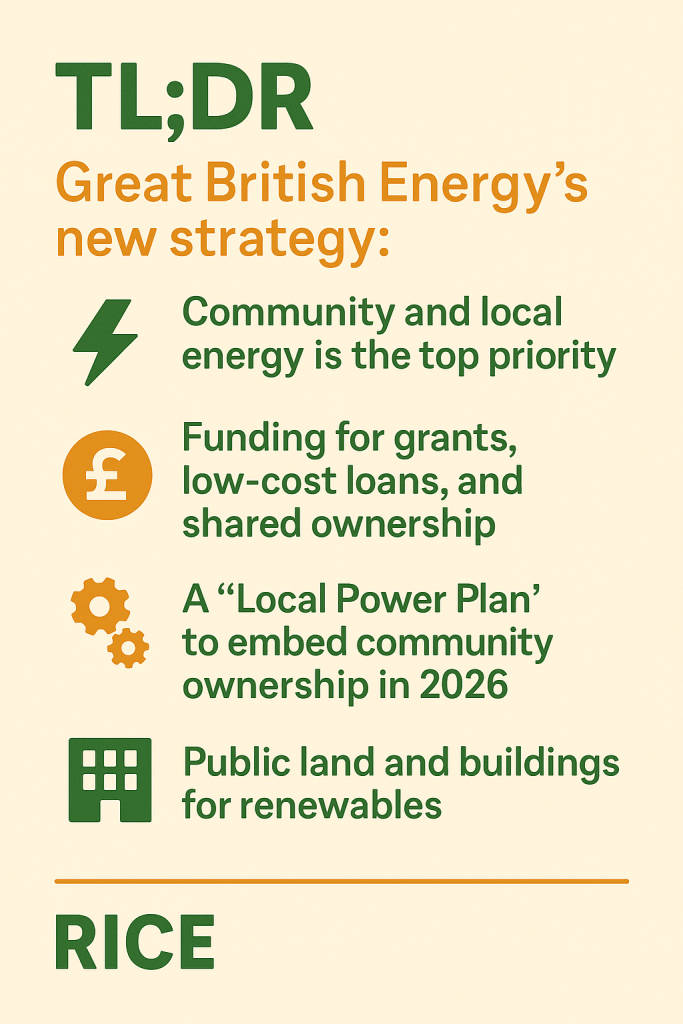
GBE’s top priority area is something called GBE Local, which exists specifically to scale community-owned and locally owned energy projects.
They’ve set a national target to support:
➡️ 1,000+ community and local energy projects by 2030
That’s huge.
This gives community groups a formal, recognised role in delivering the UK’s clean power goals, not just “nice add-ons”.
For us in Bedfordshire, it means our projects aren’t working against the tide — we’re finally aligned with national strategy.
💰 2. New funding routes are coming — grants, concessional loans, shared ownership
GBE explicitly recognises the problems all community groups face:
- Early-stage funding is hard
- Legal/technical expertise is expensive
- PPAs and grid access are difficult
- Projects take ages because we’re reinventing the wheel each time
In response, GBE will offer:
✔ Grants
✔ Low-cost loans
✔ Blended finance
✔ Shared-ownership models for communities
This is exactly the space where groups like RICE have been pushing hardest. Funding development work for solar on schools or assessing sites for rooftop PV shouldn’t be the barrier it currently is — and now, nationally, it won’t need to be.
🏫 3. Rooftop solar scaling across public buildings
GBE has already put £255 million into rooftop solar on:
- Schools
- NHS sites
- Military buildings
We’re already doing this in our area — exploring solar options for local schools, supporting residents through home energy improvements and thermal imaging surveys, and looking at routes for shared ownership.
GBE’s model could really accelerate this, especially for our ongoing work helping schools take control of their energy bills.
🛰 4. A national “Local Power Plan” arrives in 2026
This will be a joint plan between GBE and government, and it will:
- Formalise the role of community energy
- Fix policy and regulatory barriers (grid, PPAs, planning)
- Build a national support system for groups like ours
- Set out funding expectations and development pathways
In practical terms, it means community groups won’t have to navigate the system alone anymore.
For a project like Sheerhatch Solar Farm, where we are pushing for meaningful community ownership, this provides a clear route to deliver it.
🧰 5. A “GBE Local Platform” to make community energy easier
Think of this as a digital + physical toolkit for developing local energy:
- Bulk procurement (cheaper tech)
- Accredited installers
- Model PPAs and legal templates
- Project development support
- Community ownership options
- Aggregated flexibility services (battery + smart tech)
For groups like RICE, Greensand and Buzz, this reduces the admin burden and allows us to focus more on delivery and community engagement.
This could support everything from our planned school rooftop schemes to the household-level energy efficiency work we’re doing right now with thermal cameras, power-down advice and home visits.
🌞 6. Community ownership unlocks public support — and GBE knows it
The report highlights that:
84% of the public are more likely to support local solar or wind if there’s a community benefit.
This is exactly what we’re hoping to see at Sheerhatch Solar Farm, where if successful, we’ll be working with residents, councillors and partners to make sure ownership and benefit flows back into the communities.
There’s still time to get a supportive comment in on Sheerhatch, prior to the planning committee in January, head here for more info on how.
GBE is signalling a major shift: the upcoming Local Power Plan will embed community and local ownership into national energy policy, making shared ownership and local benefit a core expectation rather than an optional extra. Very exciting!
🌳 7. Big opportunity: public land for renewables
GBE’s modelling shows up to 330 km² of public land is suitable for solar, onshore wind and storage.
Local authorities and major landowners will be encouraged to partner with GBE and community groups.
This could open the door to:
- Community-backed solar parks
- Storage projects
- Joint ventures on council-owned land
- Shared ownership in larger developments
For Bedfordshire, where land availability is often a challenge, this is meaningful.
⚡ 8. The wider system will shift in our favour
GBE commits to:
- Backing long-duration storage
- Supporting grid flexibility
- Reducing curtailment
- Helping communities participate in flexibility markets
This means future projects—like battery storage linked to a solar site—are more viable.
It could also allow community groups to earn revenue from flexibility services in future, something currently almost impossible at our scale.
🧭 What this means for us — locally
Here’s where this aligns with our ongoing work:
Rooftop solar on schools
GBE funding + our local relationships = more viable projects, faster.
Sheerhatch Solar Farm
Our push for community ownership is now fully supported by the national strategy.
We’re in the right place at the right time.
Energy advice, thermal imaging, and household support
GBE’s emphasis on local capability and smart systems aligns with the practical community outreach work we’re already doing.
BET and partnership working
GBE’s plan explicitly favours collaboration across groups and regions — exactly what we’re building through Bedfordshire Energy Together.
💬 Final thought
This is the first time in UK history that a national energy body has explicitly centred communities in its strategy.
For groups like RICE, Greensand and Buzz, it’s a validation of what we’ve been working on for years — and a signal that the next phase of community energy is going to be bigger, more ambitious and more supported than anything we’ve had before.
 River Ivel Community Energy